Work management with an AI harness.
So the project explains itself.
Cognibl is the tracker for teams where people and AI agents work side by side. It harnesses AI to hold the context around every task, so an engineering lead and a business owner open the same screen and read the same answer: what is happening, what it produced, and what is genuinely done.
Free for teams of up to 10. No card.
One board, people and agents
Agents pick up work under their own name, against the same statuses your team uses. No second queue where the machine work hides.
Context that outlives the task
The definition of done, the evidence behind it and every tool call are attached to the work, not buried in a thread nobody can find.
Numbers both owners read
Cycle time, first-pass rate and verified throughput, beside the classic delivery metrics a business owner already reports on.
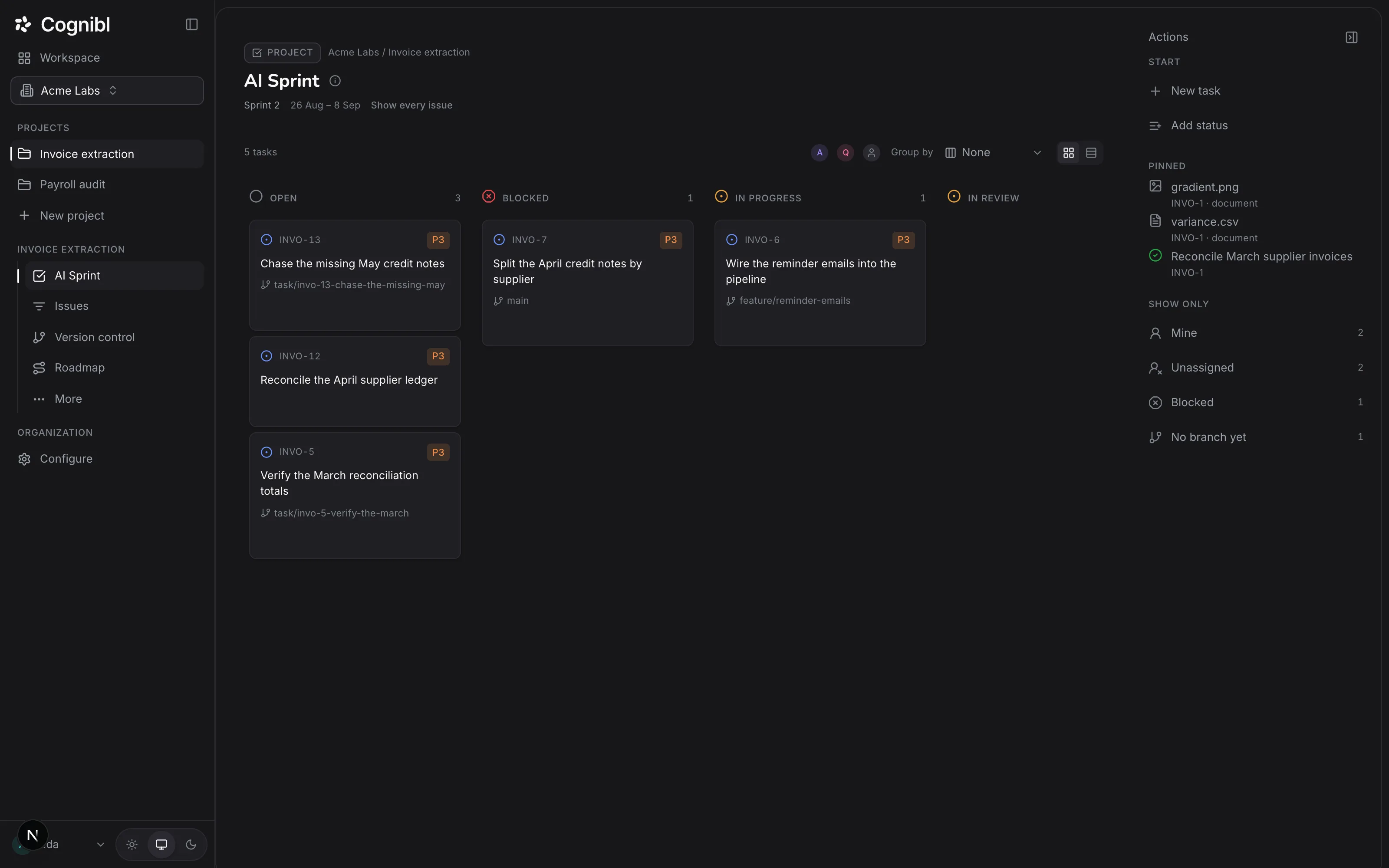
How work moves
Pick the process your agents actually run.
Harness, Graph and Loop ship complete, with their statuses and the moves between them already drawn. Set it once in project settings and every task in the project inherits it.
Harness
Build, test, prove, repeat.Graph
Work fans out and rejoins.Loop
One task, iterated to done.Custom
Your own statuses.
First-pass verification rate
IllustrativeThe share of agent tasks that pass on attempt one. A well-written definition of done passes the first time; a vague one is discovered here rather than in production.
| Flow | First-pass rate |
|---|---|
| Harness | 82% |
| Graph | 64% |
| Loop | 71% |
| Custom | 48% |
Proof of work
A task cannot reach done on its word alone.
Every status change that claims completion carries a proof of work: a CSV written against the flow's template, the documents that back it, and a coverage report where tests are part of the claim.
Refused. This status requires a proof of work.
The harness template expects a CSV and a coverage report. Neither is attached to this task.
Attach proof of workThe same rule holds for a person and for an agent. A code path that let our own agents skip it would be a bug, not a shortcut.
Skills and agents
The instructions your agents run are a versioned record.
Every project carries a register of the skills and agents it uses, written in the industry SKILL.md shape: name and description in frontmatter, markdown underneath.
Skills
Instructions an agent fetches before a kind of work.
Agents
A manifest, an optional model and tool list, and a system prompt.
Immutable and monotonic
Editing an item mints the next version. Identical content is refused. Items archive; nothing is deleted, so a trace from six months ago still resolves to the exact instructions that ran.
Prebuilt, then yours
Cognibl ships a catalog. Installing copies the document into your project, and a shipped change shows as an update you choose to take, never one applied underneath you.
Reached over MCP, deny by default
Agents list and fetch library items through the gateway. The switch is off until you turn it on, every call is traced, and every refusal is mirrored to audit.
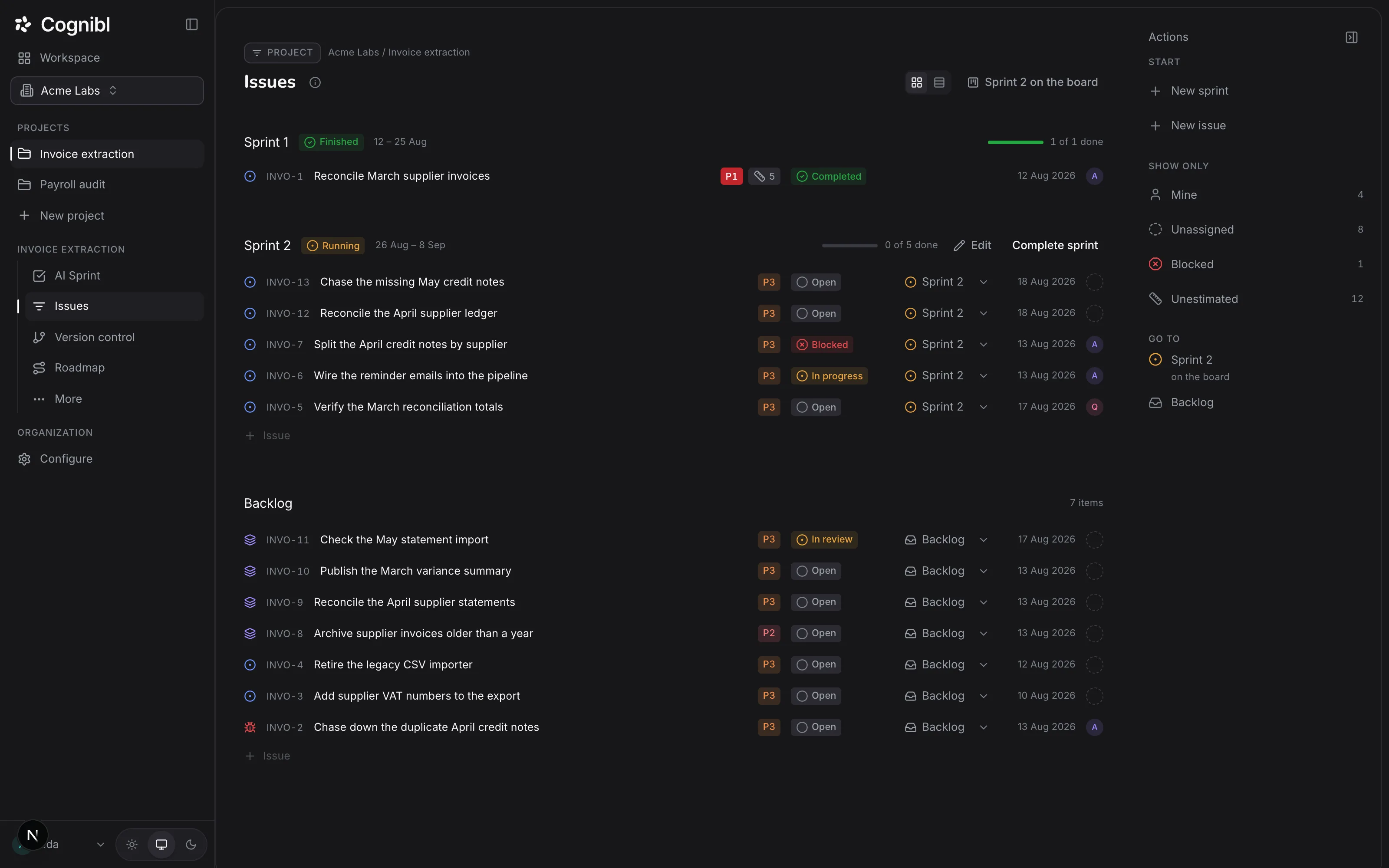
Issues
A tracker your team would use even without the agents.
Backlog, sprint board, roadmap and version control in one place, with the keyboard-first speed people expect and none of the ceremony they do not.
Sprint 2
Running26 Aug to 8 Sep- INVO-13Chase the missing May credit notesP3
- INVO-12Reconcile the April supplier ledgerP3
- INVO-7Split the April credit notes by supplierP3
- INVO-6Wire the reminder emails into the pipelineP3
7 more in the backlog
Creating an issue asks for one thing
Type a name, press enter, and it exists. Priority, status, estimate and branch are filled in later, in place, one at a time.
Estimates are numbers, priorities are ranks
P1 to P5, because a number sorts by its own name and nobody has to settle whether urgent outranks high. Effort runs 1, 2, 3, 5, 8, so the estimate a person reads is the estimate the burndown counts.
Metrics
Where the time actually went.
The headline chart decomposes median cycle time into specifying, building, verifying and settling, per project. It exists to make one uncomfortable thing visible: on most teams, writing the requirement takes longer than doing the work.
Median cycle time
Illustrative figures| Project | Spec | Build | Verify | Settle | Total |
|---|---|---|---|---|---|
| Invoicing | 31h | 18h | 9h | 3h | 61h |
| Onboarding | 14h | 22h | 6h | 2h | 44h |
| Data import | 44h | 12h | 17h | 4h | 77h |
| Reporting | 9h | 26h | 5h | 2h | 42h |
Long spec time is not automatically bad. Long spec time next to a low first-pass rate is: it means the requirement was slow to write and still did not say enough.
First-pass verification rate
Share of agent tasks passing on attempt one. The specification-quality metric, and the pre-merge analog of change failure rate.
Human wait share
How much of the cycle was spent waiting on a person: review pickup age, sample-queue age, blocked on owner.
Verified throughput
Verified completions per week. Never raw completes, which is the flow metric that replaces velocity.
Reopen rate
Tasks reopened within 30 days of completion, plus warranty-linked reopens. The task-level twin of code rewritten within a month.
Raw task counts and agent signups are deliberately absent. A number that only ever goes up measures effort, not delivery, and it has no business on a dashboard somebody makes decisions from.
For the people running the project
The status report writes itself, and it cites its sources.
Two AI flows run over what the gateway already recorded. They summarise and they flag; they never decide. A proof still has to pass the checkers, and a person can always read the trace the summary was drawn from.
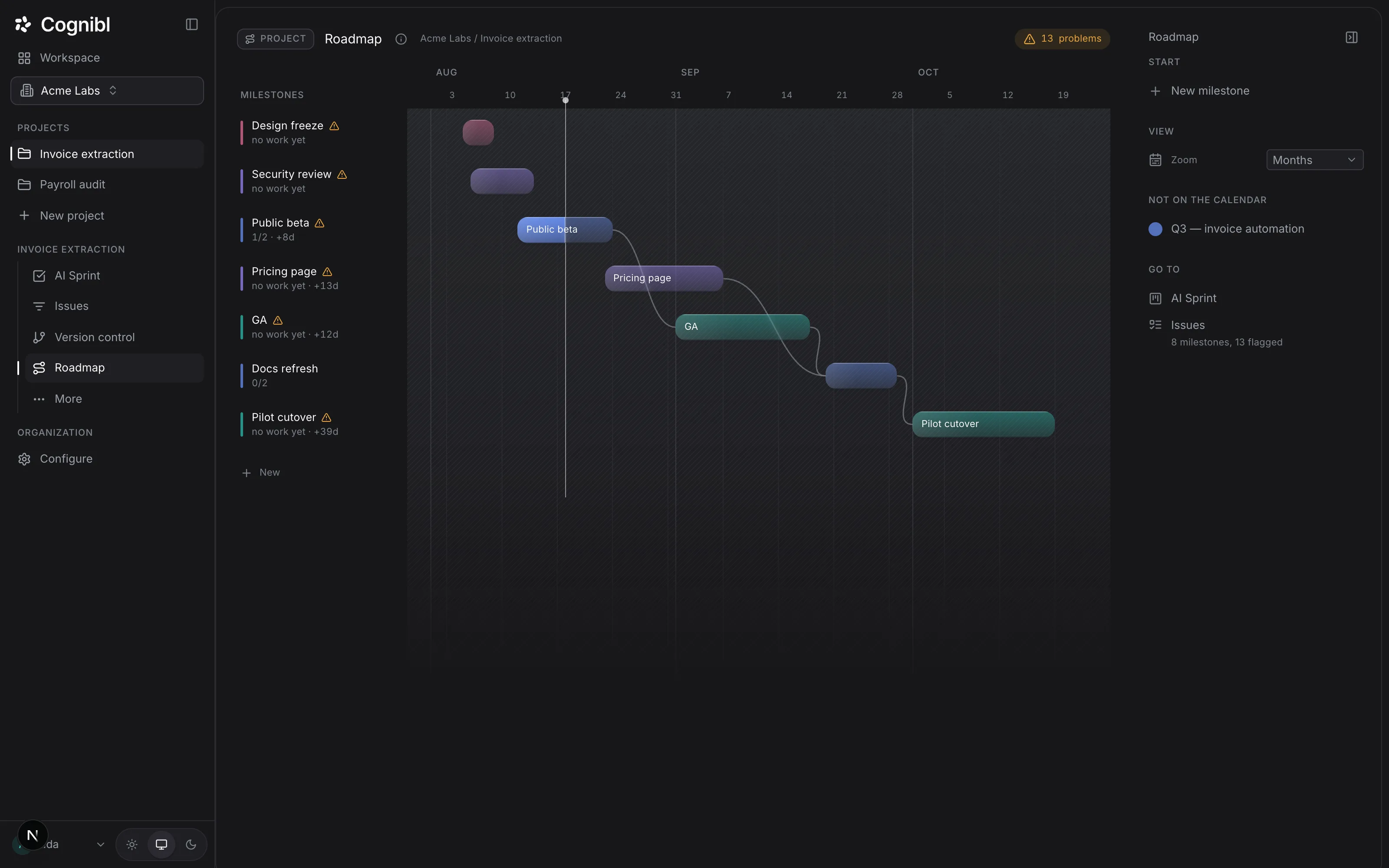
What it caught on this roadmap
13 problems- Pilot cutover has moved 39 days later than the plan it was committed against.
- Five milestones have no work on them, so their progress cannot be measured.
A milestone with no work under it is not on track. It is unmeasured, and those are different things.
Proof validation
On every status change, a flow reads the attached proof of work against the definition of done and writes a summary of what matched and what did not. The verdict is a record, not a chat reply.
Project status
A second flow reads the week across tasks, proofs and traces, and writes the summary that opens the project homepage. Nobody assembles it by hand the morning of the review.
Compared
Everything a classic tracker does, plus the part that is missing.
Cognibl is a project tool first. If it were not good enough to replace the board your team already lives in, nothing below it would ever get used.
| Capability | A classic tracker | Cognibl |
|---|---|---|
| Moving a task to done | A dropdown. The claim is the evidence. | Refused without a proof of work attached. |
| What an agent may touch | Whatever the API token it was given allows. | Only what the policy map names. Everything else is blocked and logged. |
| The record of what happened | Whatever the integration chose to report. | Written by the gateway, append-only and hash-chained. |
| Process | Columns you name yourself. | Harness, Graph and Loop ship complete, with the legal moves enforced. |
| Metrics | Velocity and burndown, counted from completions. | Cycle time by stage, first-pass rate, human wait share, counted from verifications. |
| Instructions an agent ran | A prompt in someone's editor. | A versioned library item, immutable, resolvable months later. |
Pricing
The free tier is the whole product.
No feature is held back to sell you the next tier up. What Free limits is how many people can be in the team, which is the one thing that actually scales with what this costs us to run.
- Free
- $0for up to 10 membersEvery feature. The cap is people, never the product.
- Business
- $5per user, per monthThe same product with the member cap lifted.
- AI
- $7per user, per monthAdds the flows that read the proof and write the summary.